Species Profile
The blacklegged tick (Ixodes scapularis), also called the deer tick, is now established across most of Southern Ontario. It is the only confirmed vector of Lyme disease in the province. Here is how to identify it, where it lives, and what you can do about it.
Adult blacklegged ticks are small, with a dark reddish-brown body and characteristically dark legs (hence the name). Females have an orange-red rear half of the body when unfed; males are uniformly dark. Engorged females after a blood meal swell to roughly the size of a small grape, ten times their unfed size. Nymphs are much smaller, about the size of a poppy seed, and are responsible for most Lyme transmission to humans because they are easy to miss.
Identification matters because the treatment recommendation differs from the more conspicuous American dog tick (Dermacentor variabilis), which is larger, has white markings on its back, and is not a Lyme vector in Ontario. The Public Health Ontario eTick.ca service offers free identification by photo submission and is the gold-standard reference for tick identification questions.
The blacklegged tick has a two-year lifecycle. Eggs laid in spring of year one hatch into larvae that feed in late summer (typically on white-footed mice and other small mammals). The fed larvae overwinter, molt into nymphs in spring of year two, and feed in May, June, and July. Nymphs that feed successfully molt into adults in late summer. Adults feed in fall on larger hosts (deer, dogs, humans), mate on the host, and the females lay eggs the following spring before dying.
The seasonality of human risk:
Blacklegged ticks do not live in maintained lawns. They live where their preferred hosts (mice, voles, deer) move and where there is shaded leaf litter for nymphs to develop. On a residential property, this means:
The maintained lawn surface itself is generally tick-free. This pattern is why yard treatment focuses on the lawn-wood interface rather than the lawn itself, and why landscape practices (raking the wood edge in spring, keeping a 1-metre wood-chip or gravel barrier between lawn and woods, removing leaf litter) reduce tick density without any chemical input.
Blacklegged ticks in Ontario can carry several human pathogens. Lyme disease (caused by Borrelia burgdorferi) is by far the most common. Other pathogens documented in Ontario blacklegged tick populations include the agents of anaplasmosis, babesiosis, and Powassan virus, all at lower prevalence than Lyme.
For Lyme transmission, the tick generally needs to be attached for at least 24 to 36 hours. This is the practical foundation of post-exposure response: prompt removal substantially reduces transmission risk. The recommended removal technique is a steady upward pull with fine-tipped tweezers, gripping the tick as close to the skin as possible. Save the tick in a sealed bag or photograph it for identification.
Lyme disease typically responds well to a course of doxycycline or amoxicillin when caught early. The challenge is recognition: classic erythema migrans rash appears in roughly 70 to 80% of cases but is missed when it occurs in less visible areas (scalp, groin, back). Flu-like symptoms (fever, fatigue, joint pain, headache) without other obvious cause warrant mentioning recent tick exposure to your physician.
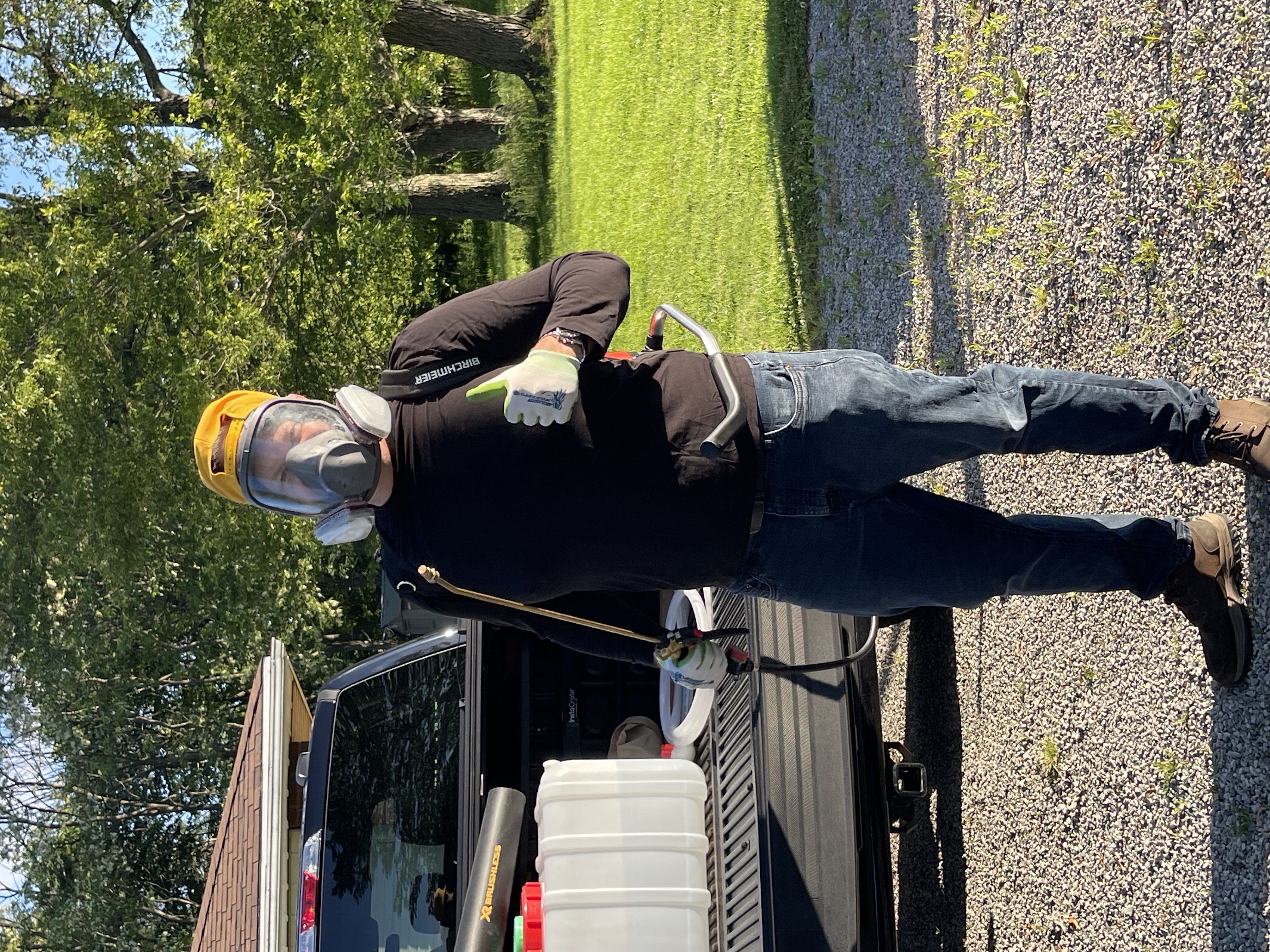
Yard perimeter treatment with a residual pyrethroid (typically bifenthrin or permethrin, both Health Canada PMRA-registered for tick use) reduces tick density on treated areas by 50 to 90% for the duration of the residual (4 to 8 weeks under typical Ontario summer conditions). The treatment targets the wood edge, ground cover, and other transition zones where ticks quest, not the open lawn.
For most Ontario residential properties in established Lyme zones (Niagara, Hamilton, Halton, Toronto, Peel, York, Durham, Simcoe, Muskoka, Kawarthas, eastern Ontario), two annual treatments cover the bulk of the activity period: late April or early May, and late July or early August. Properties with very high tick pressure often add a fall treatment in late September.
Treatment is one layer of a multi-layer defence. Personal protection (long pants, repellent, prompt tick checks), landscape practices (clearing leaf litter, maintaining a wood-chip border at the wood edge, deer exclusion where feasible), and pet-specific tick prevention from your veterinarian are the other layers. Treatment without the rest of the layers is less effective than the rest of the layers without treatment.
How small are blacklegged tick nymphs?
About the size of a poppy seed, roughly 1.5mm. They are commonly missed during tick checks for this reason. The size is the main reason nymphs (active May to July) are responsible for most human Lyme cases despite being a smaller tick than adults.
How long does a tick need to be attached to transmit Lyme disease?
Generally 24 to 36 hours, though earlier transmission is possible in some cases. This is the basis for the prompt removal recommendation: same-day removal substantially reduces Lyme transmission risk. The exact transmission window depends on the pathogen (Powassan virus can transmit in under 15 minutes, but Powassan in Ontario is much rarer than Lyme).
Where in Ontario are blacklegged ticks established?
Most of Southern Ontario. Public Health Ontario maintains an annual surveillance map showing established populations, areas under surveillance, and areas where the tick has not yet been documented. As of recent surveillance, established populations cover Niagara, Hamilton, Halton, Toronto, Peel, York, Durham, Simcoe, Muskoka, the Kawarthas, eastern Ontario, and the Lake Erie shore.
Is the deer tick the same as the blacklegged tick?
Yes. "Deer tick" and "blacklegged tick" are common names for Ixodes scapularis, the same species. The "deer" name comes from the adult feeding stage, which favours white-tailed deer. The "blacklegged" name describes the dark legs of the adult.
Can I send a tick I found for testing?
For identification, eTick.ca is the recommended Public Health Ontario service: photograph the tick and submit, identification is usually returned within 24 hours. For pathogen testing of removed ticks, options change periodically; ask your local public health unit. Identification is what matters most because the public health response and personal monitoring depends on whether the tick is a blacklegged tick or another species.
Spider Squad - Ontario Pest Control
Same-week availability across Niagara, Hamilton, and Halton. Quotes returned within one business day.
Call 905-938-7498 Request a QuoteFind Your Region
Direct service in Niagara, Hamilton, and Halton. Licensed local operators across 14 more regions.
Premium Protection
Choose the protection barrier your property needs. Simple, professional, and guaranteed.
Our flagship exterior structural barrier targets the full perimeter of your home — foundations, soffits, window frames, eaves, and all entry points. Repels and eliminates spiders, ants, and crawling insects before they enter.

A comprehensive yard-level barrier applied to shaded vegetation, ornamental shrubs, deck skirting, and property borders. Reduces adult mosquito and tick populations around your outdoor living space.
SpiderShield™ perimeter barrier
SpiderShield™ creates an invisible exterior barrier that prevents more than just spiders — blocking ants, earwigs, crickets, and other seasonal crawlers from entering your home.
Wherever You Need Us
From the shores of Lake Erie to cottage-country docks — if bugs are a problem, we’re already on the way.
Genuinely Local Exterminators
Spider Squad is a family business — not a franchise, not a call centre. Our team lives in the communities we serve, which means faster scheduling, real accountability, and treatments designed for the pest pressures specific to this part of Ontario.
Don’t Wait
Same-week service available in most communities. Get a free assessment — no obligation.
Don’t Let Spiders Take Over

Tell us about your property and we’ll respond within hours to book your service. No obligation, no pressure.